
Quality Management in Manufacturing
Quality Management is the backbone of modern manufacturing. It ensures that products meet customer expectations, comply with industry standards, and maintain consistency across every stage of production. A strong Quality Management System (QMS) reduces risk, improves efficiency, and drives continuous improvement.
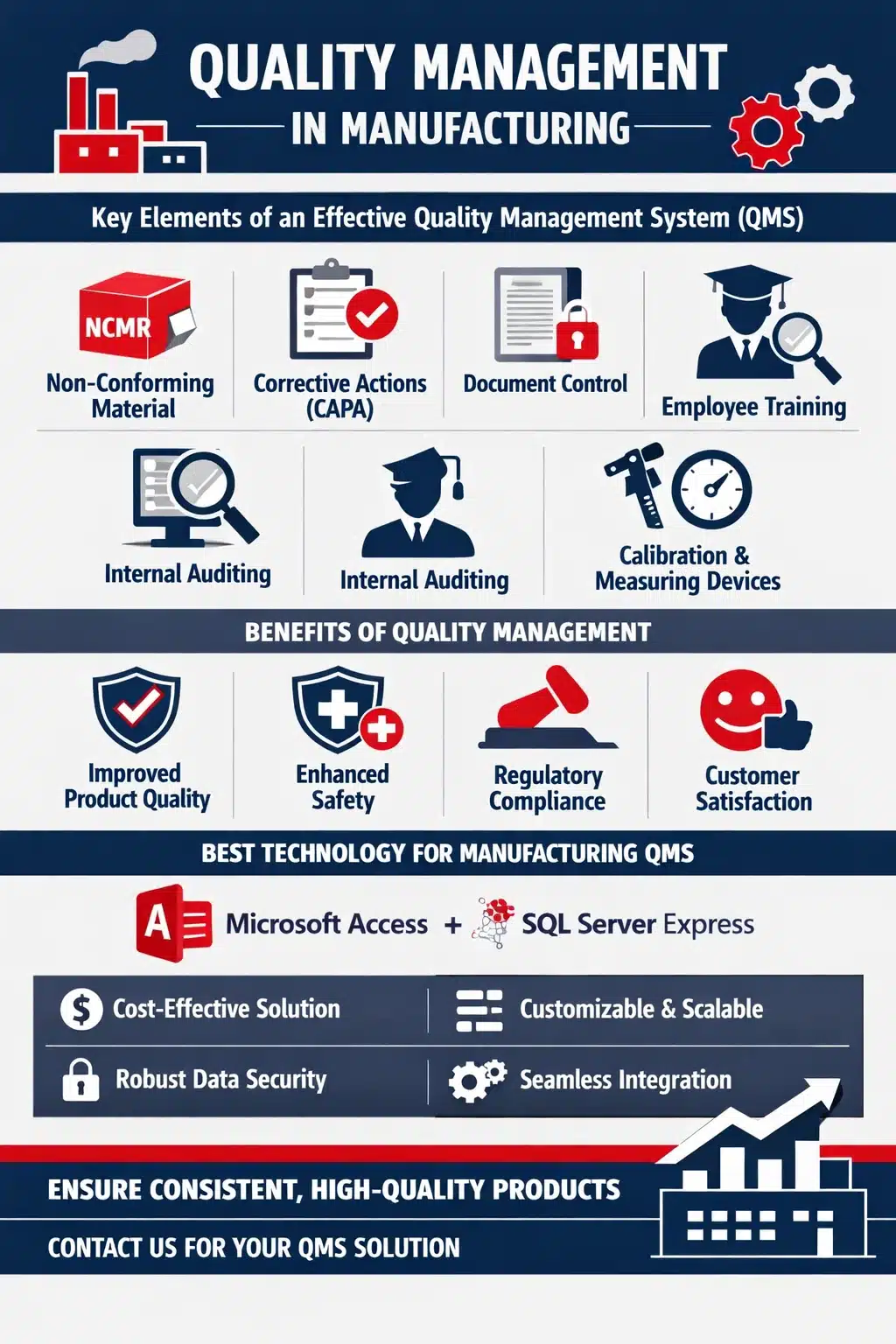
The Six Core Elements of Quality Management in Manufacturing
Manufacturing quality is built on six foundational pillars — each required by ISO 9001 and AS9100. Together, they form a closed‑loop system that ensures accuracy, compliance, and continuous improvement.
- Non‑Conforming Material (NCMR)
- Corrective Actions (CAPA)
- Document Control
- Employee Training
- Internal Auditing
- Calibration / Control of Measuring Devices
Below is a detailed breakdown of each element — and how software can streamline and automate these processes.
While many manufacturers begin by managing quality records with spreadsheets or standalone Microsoft Access databases, these systems often become difficult to maintain as quality requirements expand. Integrating every quality process into a single database improves traceability, reduces duplicate data entry, and provides management with real-time visibility into quality performance.
Learn more about our Custom Microsoft Access Development, SQL Server Integration Services, and Access to SQL Server Migration Services.
1. Non‑Conforming Material (NCMR)
Every manufacturer encounters nonconforming or defective material. What matters is how quickly and accurately you identify, record, segregate, and disposition it.
Key steps include:
- Recording part number, revision, defect details, and quantities
- Segregating and labeling material to prevent accidental use
- Notifying stakeholders automatically
- Determining disposition (Use As‑Is, Rework, RTV, Scrap, Downgrade)
- Verifying completion and closing the record
Explore our NCMR module: Non‑Conforming Material Software
Nonconforming material should never exist in isolation. Every NCMR should be traceable to the purchase order, supplier, work order, inspection records, and corrective actions that follow. Integrated databases eliminate manual cross-referencing and make audits significantly easier.
2. Corrective Actions (CAPA)
Corrective Actions prevent recurring issues by identifying root causes and implementing long‑term solutions. CAPA is essential for compliance and continuous improvement.
Corrective actions become even more valuable when they are linked directly to inspection results, nonconformances, supplier performance, employee training, and calibration history. This creates a true closed-loop quality management process that supports continuous improvement.
Typical uses include:
- Addressing product failures
- Responding to customer complaints
- Resolving supplier issues
- Improving process efficiency
- Correcting training or procedural gaps
Explore our Corrective Action module: Corrective Action Software
3. Document Control
Document Control ensures that employees always use the correct, current version of procedures, work instructions, drawings, and forms.
Effective Document Control includes:
- Centralized digital storage
- Version control and revision tracking
- Role‑based access permissions
- Automated notifications for updates
- Audit trails for compliance
Document control software should integrate directly with inspection records, training requirements, corrective actions, and engineering revisions so employees always work from the latest approved information.
Explore our Document Control module: Document Control Software
4. Employee Training
A trained workforce is essential for quality, safety, and productivity. Training ensures employees have the skills and knowledge to perform their roles correctly.
Key components include:
- Tracking training requirements and expirations
- Hands‑on and simulation‑based training
- Safety and compliance training
- Cross‑training for flexibility
- Automated reminders and reporting
Effective training systems also provide complete historical records showing which revision of a procedure each employee was trained on. This level of traceability is invaluable during ISO 9001 and AS9100 audits.
Explore our Training module: Employee Training Software
5. Internal Auditing
Internal audits verify that processes are effective, compliant, and continuously improving. They are a core requirement of ISO 9001 and AS9100.
Effective auditing includes:
- Audit schedules and planning
- Risk‑based audit scoping
- Recording findings and evidence
- Initiating corrective actions
- Follow‑up and verification
Audit findings frequently lead to document revisions, corrective actions, additional employee training, supplier reviews, and calibration evaluations. An integrated QMS keeps these relationships connected instead of scattered across multiple spreadsheets and software packages.
Explore our Internal Audit module: Internal Auditing Software
6. Calibration / Control of Measuring Devices
Calibration ensures measurement accuracy — the foundation of product quality. A proper calibration program includes:
- Tracking calibration due dates
- Recording “Condition as Found” status
- Managing certificates and traceability
- Performing out‑of‑tolerance impact assessments
- Integrating calibration with inspection and NCMR
Explore our Calibration module: Calibration Management Software
Calibration records should also identify every inspection performed using a measuring device. If equipment is later found to be out of tolerance, manufacturers can immediately identify affected inspections, products, customers, and shipments.
Why Microsoft Access + SQL Server Is a Powerful QMS Platform
Manufacturers need a QMS platform that is flexible, scalable, and cost‑effective. A hybrid architecture using Microsoft Access as the front‑end and SQL Server Express as the back‑end provides the ideal balance.
Key advantages:
- Low cost: SQL Server Express is free; Access is included in many Microsoft 365 plans
- Customizable: Tailor forms, workflows, and reports to your exact processes
- Scalable: Upgrade to full SQL Server as your data grows
- Multi‑user performance: Ideal for quality, engineering, and production teams
- Integration: Connect calibration, NCMR, CAPA, training, and audits into one system
- Traceability: Link quality records across all QMS modules
This architecture powers our QA Suite and SimpleManufacturing™ ERP , delivering enterprise‑grade functionality without enterprise‑level cost.
Many organizations already have Microsoft Access databases supporting individual quality processes. Rather than replacing these applications, we frequently modernize them by improving performance, adding new functionality, and moving the data to SQL Server while preserving the familiar Access user interface.
Learn more about our Microsoft Access Performance Optimization, Custom Microsoft Access Development, and Microsoft Access Database Repair Services.
Learn more about integration: SQL Server Integration for Microsoft Access
Why an Integrated Quality Management System Matters
Managing quality with separate spreadsheets and disconnected databases often leads to duplicate data entry, missing information, inconsistent reporting, and limited traceability. An integrated Quality Management System connects every quality process into a single database, providing complete visibility from supplier receipt through final product shipment.
When inspection records, calibration history, corrective actions, employee training, document control, and internal audits all share the same data, organizations spend less time searching for information and more time improving quality.
Our Microsoft Access and SQL Server solutions can integrate these processes into a centralized platform that grows with your organization while remaining fully customizable to your existing workflows.
Conclusion
Quality Management in manufacturing is more than compliance — it is the foundation of operational excellence. By integrating NCMR, CAPA, Document Control, Training, Internal Audits, and Calibration into a unified system, manufacturers can reduce risk, improve efficiency, and deliver consistent, high‑quality products.
With a flexible Microsoft Access + SQL Server platform, your QMS becomes scalable, customizable, and perfectly aligned with your processes.
Learn more about building a complete QMS: ISO9001 & AS9100 Quality Management Software
Transform Your Quality Management System
Our QA Suite and SimpleManufacturing™ ERP provide a complete, integrated Quality Management System and Complete ERP Software built on Microsoft Access and SQL Server.
Request a Demo